Fit a PIR light where you will walk across its detection area rather than straight towards it, at the height given for that model: 1.8 to 2.5 metres on the Endon PIR wall lights we sell, and no more than 2 metres to the base on Astro's Messina sensor light. Then set range first, time second and light level last, at dusk. We would start the timer at one to two minutes.
The clocks go back on Sunday 25 October 2026 (gov.uk), which makes this a good week to walk the route from the car to the door after dark. One customer, after ordering a pair of wall lanterns without one, told us afterwards: 'Would have preferred a motion sensor on an outdoor wall light'. Decide how the light should switch before you choose the lantern. This guide covers where a sensor goes, how to set it, why it will not switch off, and when a steady light is the better answer. Everything we stock with a sensor built in is in PIR and security lights.
What is a PIR security light, and what does it detect?
PIR stands for passive infrared. The sensor sends nothing out; it detects changes in infrared radiation as something warm, usually a person, moves through its field of view. A timer decides how long the light stays on, and most models have a light-level control to stop it working in daylight.
The detail that decides where you put one: crossing movement is generally easier for a PIR to detect than movement straight towards it. Eterna, a UK lighting brand, says in its PIR installation guide that movement directly towards or away from the sensor is less effective in triggering it, and recommends a position where people cross the detection zone. The same guide notes that all PIR detectors are more sensitive in cold, dry weather than in warm, wet weather, so expect a sensor to behave a little differently from season to season. Treat all this as a placement principle; range, angle and mounting height still come from the leaflet for your particular light.
On a lantern the sensor is a small dome on the base or the wall plate, and it switches whatever bulb you put in the holder. On a floodlight the LED is often built in. That difference matters later, when something wears out.
Where is the best place to put a motion sensor light?
Across the route people actually walk, at the height the maker gives, with nothing warm, moving or shiny in its view. In practice:
- Across the path, not down it. In a side passage, a light on the end wall looks straight down the passage and sees you head-on, the direction Eterna calls less effective. The same light on the side wall near the gate sees you cross in front of it, so it is more likely to come on as you arrive.
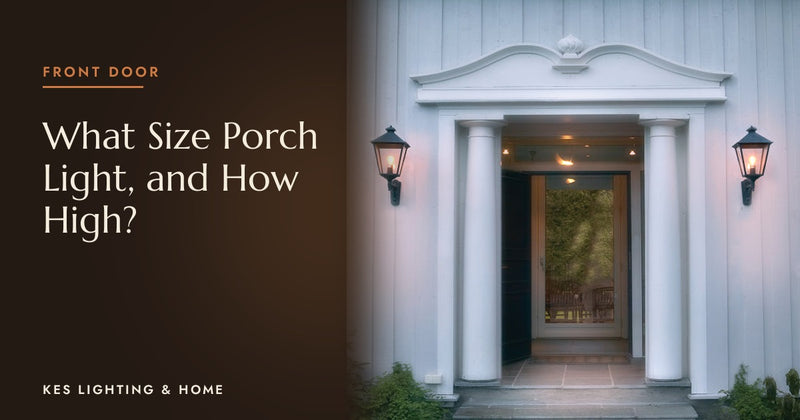
- At the front door, check the approach. Walk in from the gate and from where you park. If the path runs straight at the door, a lantern beside the door is watching you head-on, so test it before you settle on the spot nearest the existing cable.
- At the maker's height, not higher. Higher does not mean more secure. Eterna's guide notes that detection range varies with mounting height, and each leaflet gives its own figure. Endon's leaflets for the Huntington and Newcombe say 1.8 to 2.5 metres, mounted upright. Astro's Messina Sensor leaflet shows 2 metres maximum to the bottom of the fitting. Other models differ.
- Keep its view on your own property. Eterna lists trees and shrubs, smooth white walls, ponds and pools, boiler flues, vents, other outside lights, animals and moving cars as causes of false triggering. Aim away from them, away from the pavement, and keep the light out of a neighbour's window or a driver's eyes.
For a traditional porch or a tight side passage, the lantern we would start with is the Elstead Medstead half lantern with PIR (£64.50, checked 19 October 2026). It sits close to the wall, 140mm deep and 495mm tall, with the sensor in the base, and takes a separate E27 bulb. Elstead lists its sensor at 120 degrees and 1 to 8 metres, staying on for 5 seconds to 7 minutes. It is IP44; check that rating and the instructions against how exposed your wall is.

For comparison, Endon's two black PIR wall lights publish the most complete set of sensor figures we found: the Endon Huntington, a 230mm box lantern, and the ribbed glass Endon Newcombe share one instruction sheet (Newcombe copy): 110 degrees, up to 12 metres, 10 seconds to 5 minutes, fitted 1.8 to 2.5 metres up. Check availability on the product page before planning around either.
What the makers say about each sensor
Taken from each maker's own page or leaflet on 19 October 2026. Where a figure is not published, we say so rather than guess. A floodlight's beam angle describes the light, not the sensor's detection area.
| Light | Sensor | Range | Detection angle | Time on | Mounting height |
|---|---|---|---|---|---|
| Elstead Medstead and Norfolk | PIR | 1 to 8m | 120° | 5 seconds to 7 minutes | Not stated on Elstead's page; check the leaflet |
| Elstead Helsingor | PIR | 3m or 6m | Listed as 120°/360° | Six steps, 5 seconds to 8 minutes | Not stated on Elstead's page; check the leaflet |
| Endon Huntington and Newcombe | PIR | Up to 12m | 110°, fixed | 10 seconds to 5 minutes | 1.8 to 2.5m, upright |
| Collingwood 10W and 20W PIR floodlights | PIR | 2 to 8m | Not stated (the 120° figure is the light beam) | About 10 seconds to 7 minutes | Not stated; check the leaflet |
| Astro Messina Sensor and Homefield Sensor | Microwave | About 1 to 7m ahead, 3 to 9m to the sides | Not stated | About 6 seconds to 12 minutes | Messina: 2m maximum to the base. Homefield: not stated |
How far can a PIR detect, and will it pick up a car?
On the lights we sell, the published maximums run from 6 metres (the Helsingor on its longer setting) to 12 metres (the Endon PIR lights), with the Medstead at 8. Treat those as a guide rather than a promise. Astro bases its own figures on an average-sized person moving at 1 to 1.5 metres a second; direction of movement, installation and conditions all change the real distance, and someone walking straight at a PIR is usually picked up later.
And yes, a moving car can set one off. Eterna lists moving cars among the causes of false triggering. A sensor that can see the road lights up for passing traffic, which is a nuisance for you and for the house opposite. Turn the range down or move the sensor until the pavement falls outside it, then walk-test your own route again.
For a modest drive or parking space, the Collingwood 10W PIR floodlight (£30.64, checked 19 October 2026) is the one we would start with: 1,100 lumens at its 3000K setting according to Collingwood's spec sheet, IP65, and a head that rotates and tilts so the light lands on the drive rather than the street. The 20W version (£39.75, checked 19 October 2026) gives 2,200 lumens at 3000K for a wider area. Our rule of thumb is to buy the smaller one first: more output does nothing for where the sensor sees, and the brighter the flood, the more care the aim needs to keep glare off the neighbours. Our driveway and path lighting guide covers where glare becomes a nuisance.


What are the three settings on a PIR, and what should they be set at?
Many PIR lights have up to three controls, often small dials or screws under the sensor:
| Control | What it changes | How to start |
|---|---|---|
| SENS | How far away it reacts (sensitivity or effective range) | Start low and increase until your route is covered |
| LUX | How dark it must be before it works at all | Use the daylight end for testing, then adjust at dusk |
| TIME | How long the light stays on after the last movement | Minimum for testing, then a working value |
Not every light has all three, and some click through fixed steps. The Elstead Helsingor PIR lantern (£71.02, checked 19 October 2026) in 304 stainless steel is listed by Elstead with two ranges (3 or 6 metres) and six times from 5 seconds to 8 minutes. Endon's leaflets have you adjust the TIME and SENS screws with a small screwdriver behind a flip cover.

How to set one up
Follow the walk-test steps in your model's leaflet. The order below matches what the Astro, Collingwood and Eterna instructions describe.
- For a daytime set-up, turn LUX to the daylight end. Astro's leaflets and Collingwood's both say the light-level control must be at the daylight end to test or adjust range in daylight.
- Turn TIME to minimum, so the light goes off quickly between tests.
- Set the range with a helper. Start low, have someone walk in from the gate, the door and the parking space, and turn SENS up until each route is covered but the pavement is not. One buyer of the Medstead found there is no walk-test mode, and that 'simply covering the PIR for a second or two served the purpose'.
- Set TIME to its working value. Our starting points are below.
- Set LUX last, at dusk. Eterna's method: wait for the light level you want it to start working at, then turn LUX slowly from the daylight end towards night while someone walks across the detection area, and stop when the light switches on.
Our starting settings, which are our rule of thumb rather than any maker's figure. Live with them for a week, then adjust for the people using the space.
| Where | Range | Light level | Time |
|---|---|---|---|
| Front door or porch | Low to middle: the path, not the pavement | Dusk | 1 to 2 minutes |
| Side passage, bins | Middle | Dusk | 1 minute |
| Back door, garden steps | Middle | Dusk | 2 to 3 minutes, time to carry things or take steps slowly |
| Drive (floodlight) | Middle to high, kept off the road | Dark | 2 to 3 minutes |
Why we start short: Astro's leaflets note that any movement before the time runs out restarts the timer, so while someone is moving about the light stays on anyway. A longer setting mainly decides how long it burns after everyone has gone. Lengthen it where someone needs more time, such as on steps or for anyone who moves slowly.
Why is my PIR light staying on, and how do I reset it?
Check the instructions before assuming the sensor has failed. Work down this list in order; the first two cost nothing.
- It is in manual override. Some PIR lights have a stay-on mode worked from the wall switch, and it is easy to trigger by accident. The sequence differs by model, so use your leaflet: on the Collingwood floodlights it is off and on four times within 6 seconds, and Collingwood's instructions say switch off and back on to return to sensor mode; on the Endon Huntington and Newcombe it is twice within 3 seconds, and Endon says switch off for more than 6 seconds, then on.
- It is warming up. After the power comes on, the Collingwood stays lit for around 15 seconds while the sensor starts, and Endon's warm-up is up to about a minute.
- Something keeps moving. Turn TIME to minimum for testing and look for traffic, animals or branches inside the detection area.
- Something warm or reflective is in its view. Eterna's test: cover the sensor with a thick cloth. If the light then goes off, look in its view for a boiler flue, a vent, a pond or a smooth white wall, then turn the sensor away or the range down.
- An installation or electrical fault. Eterna notes that switching fans or lights on the same circuit, or a faulty switch, can trigger a sensor. If settings and position do not cure it, ask an electrician to check the fitting and the circuit.
Do not open the fitting or alter the wiring as part of a sensor test. Two further points from the leaflets: Collingwood says a neon indicator in the switch or fused spur stops its override working, and Endon's leaflets ask for connection via a wall switch so the light can be safely isolated, which is also how its override and reset work. Sensors can carry their own guarantee; for its Helsingor family, Elstead guarantees the PIR sensor against fault for two years.
To reset one, use the maker's method and allow its stated warm-up. Where the leaflet gives no off period, our habit is to leave it off at the wall switch for a full minute, which is longer than any leaflet we read asks for, then switch on, wait and walk-test.
PIR, microwave or dusk-to-dawn: which is better?
For lighting a route while someone passes, PIR, in our view. Microwave sensors work differently and can react through some materials, and a dusk-to-dawn photocell answers a different question: steady light rather than light on demand.
| Type | How it switches | Where it suits | What to watch |
|---|---|---|---|
| PIR (passive infrared) | Detects a change in infrared as something warm moves in its view | Paths, side passages, bins, drives | Less effective head-on; false triggers from heat and movement in view |
| Microwave (high frequency) | Sends out a low-power signal and detects movement in it | Where the sensor is built into the fitting | Can detect through some materials, so check range and neighbouring movement; keep units apart |
| Dusk-to-dawn photocell | On at dusk, off at dawn | A low, steady light at an entrance | On all night, so keep the output low |
| Manual switch | You decide | Lights for an evening in the garden | Nobody remembers to switch it on as they leave |
Microwave sensors (Steinel calls its version high frequency) send out a low-power signal and detect movement in it. Steinel's datasheet for its RS LED A1 sensor light lists detection through glass, wood and stud walls, which is how it can hide the sensor behind an opal shade. Outside, that reach means range and neighbouring movement need more care than with a PIR.
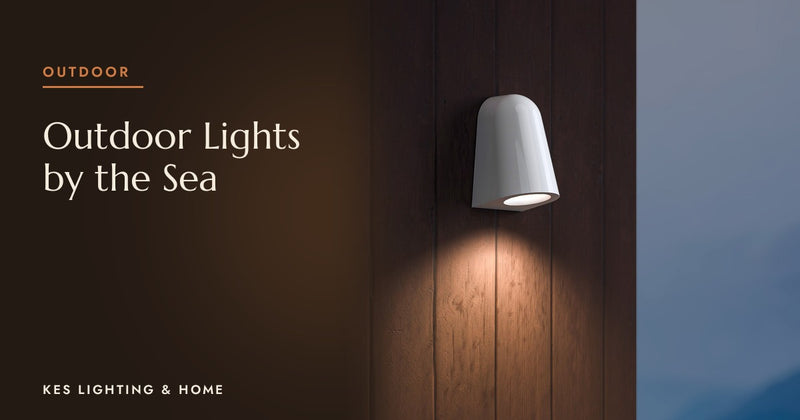
We stock two microwave sensor lights, both Astro, both IP44 and both in textured black. The Astro Messina Sensor (£193.89, checked 19 October 2026) is a 350mm box lantern; the Astro Homefield Sensor (£212.52, checked 19 October 2026) is the 250mm version. Astro's Homefield instructions give a range of about 1 to 7 metres ahead and 3 to 9 metres to the sides, 6 seconds to 12 minutes on time, a light level from 2 to 2000 lux, and a rule worth copying: fit them more than 4 metres apart to avoid interference. Neither is dimmable, and neither should be described as PIR. Buy one for the look, then set the range low.


At the front door, our preference is a low, steady light, so visitors can see the step and you can see their faces. The police lean the same way. Avon and Somerset Police suggest considering dusk-till-dawn lighting that gives a constant low light, and note that PIR lights can be easily activated by animals and visitors, which may lower their effectiveness. ProtectUK, the counter-terrorism policing site, adds for premises that evidence has shown lower levels of continual light to be a more effective deterrent than sudden, bright lights, while a motion detector can reduce running costs. A well-placed sensor can still be useful at an entrance; we would simply not rely on it alone. Whether a porch light should burn all night, and what that costs, is in our front door lighting guide.
What are the downsides of motion sensor lights?
- False triggers. Cats, foxes, birds, branches, passing cars and warm air from a flue can all set one off. Most of that is fixed by aim and range rather than by a different light.
- A sudden light is not the best deterrent on its own. See the police guidance above. A PIR lights your way; it does not guard the house by itself.
- Neighbours. A bright sensor light that fires across the boundary every time a cat crosses will be noticed. Our driveway guide covers when outside lighting becomes a nuisance.
- What wears out. A lantern takes a bulb you can change separately. Collingwood says the LED in its floodlights is not replaceable, so when it fails the whole fitting is replaced. Its 50,000-hour L70 figure is a light-output rating, not a promise that the fitting lasts that long; the warranty is 5 years. Sensors can carry different terms from the body, as on Elstead's Helsingor.
- No dimmers. Astro's leaflets mark its sensor lights unsuitable for dimming and the Endon PIR lights are listed as non-dimmable. Wire them to a plain switch.
For the bulb, a warm LED suits a lantern. Elstead suggests an 8W, 800 lumen, 3000K clear LED lamp alongside the Medstead, which we think is plenty for a porch. If you are unsure which bulb a fitting takes, our guide to which bulb a light needs will tell you.
Are outdoor motion sensor lights worth it?
Yes, wherever you need light for a minute rather than an evening: the side passage, the bins, the back door, the garage, the drive. They save hunting for a switch with your hands full, and they do not burn all night. At the front door we would pair a sensor with, or choose instead, a low steady light, for the reasons the police guidance gives.
If you have already fallen for a lantern without a sensor, there are three routes. Look for the PIR version of the same design: the Elstead Norfolk PIR lantern (£61.50, checked 19 October 2026), hand-leaded glass on a scrolled bracket, is also sold without the sensor, and Elstead lists the same 1 to 8 metre, 120 degree sensor as the Medstead. It is rated IP43 rather than IP44; our preference is a wall with some shelter, and its instructions must permit the exposure you have in mind. Our outdoor IP rating guide explains the codes. Or ask an electrician whether a separate sensor can switch the lantern you love. Or, where there is no cable at all, a solar light with a sensor: the Les Jardins Corner solar wall light (£314.74, checked 19 October 2026) charges by sun or USB-C, is IP66, and its switchable sensor lifts it to 500 lumens for 30 seconds when it detects you.

Can you fit one yourself?
We recommend a registered electrician for mains outdoor lighting, and notification rules vary by country and by the work. In England, Part P of the Building Regulations covers fixed lighting on outside walls, and Approved Document P makes a new circuit notifiable, while replacing an existing fitting, or adding to an existing circuit outside a special location, is not. Wales, Scotland and Northern Ireland have their own rules. Not notifiable is not the same as a job for anyone: Collingwood's leaflet says its floodlights must be wired by a qualified electrician or suitable competent person. Our driveway and path guide sets out who can fit what outdoors, and if you live near the sea, read our coastal outdoor lighting guide before choosing a finish.
Before anyone drills a hole, walk the route at dusk. Where you naturally cross in front of the wall is where the sensor goes.
The short version
- Mount a PIR where people walk across its detection area. Head-on is its less effective direction.
- Fit it at the height in its leaflet (1.8 to 2.5m on the Endon PIR lights, 2m maximum to the base on Astro's Messina), not higher.
- Keep flues, vents, branches, ponds, white walls and the road out of its view.
- Set range first with a helper, then time (we start at 1 to 2 minutes), then light level at dusk.
- Stuck on? Check the override and warm-up in the leaflet first, then cover the sensor with a cloth to find a heat source.
- PIR for routes you pass through; a low, steady light at the front door. Use a registered electrician.
Frequently asked questions
How long should a motion sensor light stay on?
We start at one to two minutes at a door and two to three where people carry things or use steps, then adjust for the people using it. On many models any movement restarts the timer, so a long setting mainly keeps the light on after everyone has gone. Ranges run from about 5 or 10 seconds to 5, 7, 8 or 12 minutes.
How do I reset a PIR security light?
Use its instructions, because the off period, override sequence and warm-up vary. Endon asks for more than 6 seconds off and allows about a minute to warm up; Collingwood's floodlights light for around 15 seconds on start-up. Where no figure is given, we leave it off at the wall switch for a full minute, then walk-test it.
How do I turn off the sensor so the light stays on?
Some lights have a manual override worked from the wall switch, and the sequence differs by model. On Collingwood's PIR floodlights it is off and on four times within 6 seconds; on Endon's PIR wall lights, twice within 3 seconds. Each leaflet explains how to return to sensor mode.
Will a PIR light come on for a car?
It can. Eterna's PIR guide lists moving cars among the causes of false triggering. If the sensor can see the road, turn the range down or reposition it until the pavement and street fall outside its view, then walk-test your own route again.
Is a brighter security light better?
Only if the area needs more light. More output does not change where the sensor sees, and a brighter flood needs more care with aim and glare. We would choose the lowest output that lets you see the drive or path, and keep the light on your own property.
What is the best type of motion sensor for outside lights?
For lighting a route as someone passes, PIR, in our view. Microwave sensors can detect through some materials, such as glass and thin walls, so range and neighbouring movement need more care. A dusk-to-dawn photocell suits a low, steady entrance light rather than light on demand.