Measure the base from the table to the top of the lampholder, then choose a shade about four-fifths of that height across and about half of it tall. A 400mm base takes a shade around 320mm wide and 200mm high. That is our own rule of thumb, and the check for it is below.
Get it right and the lamp looks intended. Get it wrong and a perfectly decent base looks as if it has borrowed someone else's hat. Size is only the first of four decisions: the shape sets the look, the fabric sets what the light does to the room, and the fitting decides whether the shade goes on at all. The range is in our lampshades, and this guide will get you to the right one.
How do you measure a lamp for a new lampshade?
Three measurements and one look at the old bulb. Do it before you fall for a fabric.
- Base height. Stand the lamp on a flat surface and measure from that surface to the top of the lampholder. Leave out the old shade, the finial and the bulb.
- The widest part of the base. Measure the body of the lamp. A flat foot does not count.
- What it stands on. Width and depth of the table, because a shade can overhang the furniture while looking fine on the base.
- The bulb cap. E27 is the large screw, E14 the small screw, B22 the bayonet. Our guide to E14 and E27 fittings covers the difference.
Replacing a shade you already like? Measure that as well: across the bottom, across the top, and straight up the side for height. Slant height is the diagonal down the fabric, so on a tapered shade it reads longer. Our Endon Rattan 31cm (£38.30, checked 2nd November 2026) is 310mm across the bottom, 100mm across the top and 160mm high, which makes the slant about 191mm. Read a listing's height carefully for that reason.
What is the rule for lampshade size?
Ours, for a table lamp of ordinary proportions: shade width is four-fifths of the base height, and shade height is half of the base height. It is a rule of thumb. Nobody regulates this, and your eye gets the last word.
| Base height | Shade width | Shade height | A real shade near that size |
|---|---|---|---|
| 300mm | 240mm | 150mm | Endon Ayla 22cm, 220 x 130mm |
| 400mm | 320mm | 200mm | Astro French Drum 330, 330 x 200mm |
| 500mm | 400mm | 250mm | Endon Leaf 40cm, 400 x 275mm |
| 600mm | 480mm | 300mm | Astro Drum 500, 500 x 250mm |
You will read a more generous rule on many sites: width equal to the base height, and height two-thirds of it. We treat that as the upper limit. We checked both against the shades listed for bare bases in our own range, and the smaller figure lands closer on the modern ones.
| Base | Base height | Shade listed for it | That shade | Our sum |
|---|---|---|---|---|
| Astro Park Lane Table | 395mm | French Drum 330 | 330 x 200mm | 316 x 198mm |
| Astro Beaumont Table | 430mm | Drum 300 | 300 x 200mm | 344 x 215mm |
| Astro Venn Table | 407mm | Stadium 220 | 310 x 220mm | 326 x 204mm |
Every one is within 5cm. Worked through in full: the Astro Park Lane Table in bronze (£91.08, checked 2nd November 2026) is sold as a bare 395mm base. Four-fifths is 316mm and half is about 198mm. Astro lists the French Drum 330 in white (£115.06, checked 2nd November 2026) for it, at 330mm by 200mm. It comes as a pack of two, so it suits a pair of bases either side of a bed or a sofa, and it is the pairing we would buy.
There are honest exceptions in both directions. Slim modern columns often go smaller on purpose: the 570mm Astro Ravello Table is listed with a 250mm drum, a small head on a long neck, and if that is the look you want, follow the listing. Traditional vase shapes carry far more. The Elstead Sashi (£159.95, checked 2nd November 2026) wears an ivory cotton box-pleat shade 400mm across and 280mm deep on a base 165mm wide, and one reviewer, Brian S., wrote: 'Elegant, well-proportioned lamps'. Caught between two sizes? Go larger. A slightly generous shade looks chosen. A slightly mean one looks like a mistake.


How do you check the size is right?
Divide the shade width by the height of the finished lamp. We ran that sum on 101 fabric-shaded table lamps in our range on 2nd November 2026. The typical answer was 0.6, and the middle half fell between 0.53 and 0.64. So a finished table lamp is about three-fifths as wide as it is tall.
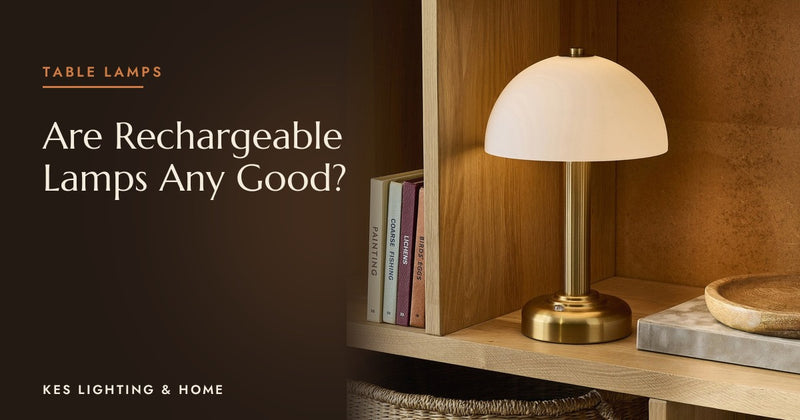
The Endon Hayfield in brushed bronze (£103.00, checked 2nd November 2026), the lamp in the photograph at the top of this guide, is 590mm high with a 370mm shade: 0.63. To check a shade on a bare base, you need the gimbal drop, the distance the fitting sits below the top of the shade. Put the Endon Ayla 31cm (£27.36, checked 2nd November 2026) on a 400mm base. It is 310mm wide with a 13.5cm drop, so the finished lamp is about 535mm tall, and 310 divided by 535 is 0.58. Comfortably inside the range, and within 10mm of what the rule asked for.
If your answer is well under 0.5, the shade is too small for the base. Over about two-thirds, it is too big unless the lamp is a deliberately traditional piece. Then do the cheap test: cut a card to the shade's width, hold it over the base and look at it from the sofa.
Should a lampshade be wider than the base?
Yes. Our rule is at least 5cm clear each side of the widest part of the body, which is why a round-bellied lamp needs more shade than a stem of the same height. The Sashi above clears its 165mm base by 117mm each side. If the shade is the same width as a bulbous base, it stops looking like a shade.
It also has to suit the furniture. Take a 400mm base in a 4 by 4 metre living room. On a 600mm side table, a 320mm shade leaves 140mm each side, which is plenty. On a 300mm deep console, a 330mm round shade overhangs by 15mm at front and back, and you will catch it every time you pass. There we would use the Astro Rectangle 285 in white (£44.16, checked 2nd November 2026): 285mm wide but only 150mm deep, so it leaves 75mm front and back. Our guide to table lamps for a living room covers the lamp and the table together, and living room table lamps has the finished versions if you would rather buy both as one.
What size shade does a floor lamp need?
About three-tenths of the base height across, with a shade height about three-fifths of its own width. The table lamp rule falls apart here: four-fifths of a 1400mm stem would be a 1.1 metre shade. This one is ours too.
| Base height | Shade width | Shade height | A real shade near that size |
|---|---|---|---|
| 1300mm | 390mm | 234mm | Astro Rectangle 400, 400 x 265mm |
| 1400mm | 420mm | 252mm | Astro Drum 420, 420 x 250mm |
| 1500mm | 450mm | 270mm | Astro French Drum 440, 440 x 250mm |
| 1600mm | 480mm | 288mm | Astro Drum 500, 500 x 250mm |
Two real bases agree. The Endon Twist Floor Lamp (£88.14, checked 2nd November 2026), at that price the base alone in satin almond white, stands 1400mm tall, and its listing says it suits 35cm or 40cm shades. The sum says 420mm, so 40cm is the one we would take, and the Endon Leaf 40cm (£52.75, checked 2nd November 2026) is the obvious partner: gathered faux linen, 400mm across, 275mm high. The 1353mm Astro Beaumont Floor gives 406mm by the sum, and is listed with the Astro Drum 420 in white (£148.61, checked 2nd November 2026). Finished floor lamps in our range run at a little over a quarter as wide as they are tall.
One sum that catches people out: a 400mm shade needs its centre 200mm from the wall, so the stem cannot stand tight in a corner. For position and reading height, see how to choose a floor lamp for a living room. If you are still choosing the lamp, our picks are in the best floor lamps for a living room.


Which lampshade shape should you choose?
Choose by the base first, then by where you want the light. The top opening matters more than people expect. The Endon Leaf 40cm has a 280mm top and the Rattan 31cm has a 100mm top, so the Leaf has nearly eight times the open area for light to go up. A wide top puts light on the ceiling, which lifts a room. A narrow top keeps the light low.
| Shape | How to spot it | What it does | Where we would use it |
|---|---|---|---|
| Drum | Straight sides, same width top and bottom | Most light up and down, evenly | Modern stems and plain columns |
| Tapered drum | Slightly narrower at the top. Astro calls it a French Drum | A little more light down, softer outline | Nearly any base. Our safe bet if you are unsure |
| Empire | Narrow top flaring to a wide bottom, usually deep | Sends light down and out | Vases, ginger jars, anything turned or carved |
| Cone | Small top and steep sides | A pool of light below, little above | Bedside, wall lights, small pendants |
| Rectangle or oval | Flat-sided, wider than it is deep | Keeps its depth off the wall or the table edge | Consoles, narrow tables, wall lights |
Drum or empire on a modern table lamp? Drum, and we would not argue long about it. An empire on a plain steel stem looks like a costume. The reverse also holds: a wide straight drum on a fat ceramic vase rarely looks settled, and that is where a taper earns its keep. Square and rectangular shades look best when something on the base answers them. The Park Lane's rectangular foot would carry the Rectangle 285 happily.
Pleats and scallops are decoration, and good decoration is reason enough. The Astro Tapered Round 400 pleated in putty (£204.22, checked 2nd November 2026) catches light and shadow in narrow stripes, and the Ayla's scalloped edge turns a plain base into the point of the lamp. Both are for bases that can stand a bit of competition.


What does the fabric do to the light?
A shade makes no light. It decides where the light goes and what colour the glow is. That is why the lampshade that brightens a room most is pale, translucent and open at the top, and why fitting a larger shade will not make a dim lamp bright. Change the bulb for that.
| Material | What it does | Our view |
|---|---|---|
| White polycotton | Diffuses evenly, adds no tint | The dull answer, and usually the right one in a room short of light |
| Putty polycotton | A tone between grey and stone | Warmer to look at unlit. Suits brass, nickel and dark wood |
| Oyster silk | Natural variation in colour and texture | Worth paying for on a lamp you look at closely |
| Vintage white cotton | A warm off-white glow | Gentle and forgiving, and our pick for a bedroom |
| Natural rattan | The weave softens the light | Texture first, brightness second. For atmosphere, not for reading |
| Printed faux linen | Pattern over a plain inner lining | The way to add colour without repainting anything |
| Black polycotton or steel | Little or nothing through the side | Light goes up and down in two pools. A mood rather than a main light |
Be honest about dark shades. The Astro Semi Drum 320 in black looks sharp in a dark study, but it will not lift a room. One reviewer of a fitting with brown shades, Margaret S., was very pleased and added: 'when they're switched on the shades look like they're black'. Buy it for that effect, or not at all. Whatever the fabric, use warm white, because cooler light makes a fabric shade look harsh: warm white or cool white goes through it room by room.
Can you put any lampshade on any base?
No. The size rule tells you what will look right. The fitting tells you what will physically go on. Many of the shades we list sit on the lampholder on a gimbal, the ring and arms inside the shade. One buyer of an Elstead table lamp, Paul O., liked the way the shade 'locates on that sort of gimble so the shade is always level', which is as good a definition as any. These are the words to look for on our listings.
| What the listing says | What it means for you | Example |
|---|---|---|
| E27 gimbal, reducer included | Made for an E27 lamp. B22 and E14 are not stated, so we would treat it as E27 only | French Drum 330 |
| Gimbal fits E14 and B22 | A small hole. E27 is not listed, so do not assume it | Endon Ayla 22cm |
| Gimbal fits B22, E14 and E27 | The broadest fit we list | Endon Ayla 31cm and Rattan 52cm |
| Reversible gimbal | Flips over, so one shade works on a table lamp, a floor lamp or a pendant cable set. E27 or B22 | Endon Leaf 40cm |
| Clip-on | Clips to the bulb, for bare lamps on a chandelier arm | Diyas Crystal Clip-On |
| 'For use with the Astro Tacoma range only' | Made for one family. It will not go on anything else | Astro Tacoma glass shades |
| Designed for two E14 lamps | An oval for a twin-lampholder base, so check yours has two | Interiors 1900 Kemp 18 Inch oval |
Hole size is the thing to check. UK shade maker Floren gives gimbal washers as 42mm for ES, 28mm for BC or SES, and 20mm for SBC. In our terms, that means E27 is the big hole, with B22 and E14 smaller. If the hole is too large for your lampholder, a reducer ring is the usual fix. If it is too small, no ring will help. Change the shade.
You will meet other words on other sites. Spider, harp and uno come mainly from American guides: Floren describes uno fittings as 'Typically used in the US', and our shade listings do not use any of the three. A duplex fitting is, in Floren's words, used 'with a shade carrier'. We do not list a shade by that word. On some Astro glass fittings, 'duplex' describes the glass itself. It has nothing to do with how a shade attaches.
How far should the bulb be from the lampshade?
We cannot give you a safe distance in millimetres. We did not find one in the UK safety guidance we read, and we will not invent one. What the guidance does say is plain.
- Electrical Safety First: 'Never use a light bulb which is over the recommended power rating for your lamp.'
- Scottish Fire and Rescue Service: check the shade's maximum wattage, because 'higher watt bulbs can cause the shade to overheat and catch fire'. Never cover a bulb or a lampshade.
- Cleveland Fire Brigade: 'Keep lights and bulbs away from fabric'.
So read the limit on the base and stay under it. The Park Lane allows 60W, the Twist 10W, and our E27 GLS LED (£9.60, checked 2nd November 2026) draws 7W, so it suits both. Our own practice beyond that: the glass must not touch the fabric, and a shade that feels hot or shows a mark comes off and the bulb gets changed. If you are asking whether it is the size or the clearance, treat it as both and stop using it until you have fixed it.
The drop also decides whether you see the bulb. On the Endon Ayla 22cm it is 9.5cm. Our E14 golf ball (£5.95, checked 2nd November 2026) is 73mm tall and sits well inside. Our E14 candle (£8.69, checked 2nd November 2026) is 100mm tall, so it is the one to check. A reviewer of a three-light table lamp, Gillian C., bought candles and wrote: 'They came up too far above the lampshade'. Mini globes, in her words, 'were perfect'.
See the bulb from underneath instead? The shade is too short or the lamp is too tall. The bottom of the shade belongs around seated eye level, which is the whole argument of the best bedside lamps for reading. For a bedside base of about 300mm, the Ayla 22cm is the size we would try first.


Which lamps and pendants need a shade?
Anything sold without one, and our listings say so: 'without shade', 'base only', 'shade not included'. Read past the photograph. The Astro Caserta wall light's listing says of its black shade that it 'shows the idea, and is not included'. Budget for both before you get attached, and buy the bulb at the same time: the Park Lane and the Twist do not come with one.
- Table lamps: Astro's Park Lane, Beaumont, Club, Edward, Ravello and Venn bases all take a shade you choose. Use the rule, then the shades named on the listing.
- Floor lamps: Astro's Beaumont, Edward, Park Lane, Ravello and Venn, plus the Twist as a no-shade option.
- Wall lights: stick to the shades the listing names. If half the shade's width is more than the bracket's reach from the wall, the shade will touch the wall, whatever the rule says.
- Chandeliers: bare candle arms can take a clip-on, if you want to dress the lamps rather than show them.
A pendant is a different sum, because it answers to the room rather than a base. Our sizing rule from what size ceiling light does my room need is the room's length plus width in metres, times 8, for a diameter in centimetres. A 3 by 3.5 metre bedroom gives 52cm, which is the Endon Rattan 52cm (£74.75, checked 2nd November 2026) on the nose. Take 2.1 metres off the ceiling height for the drop you can afford over a walkway: under 2.4 metres that leaves 300mm, and the Rattan is 220mm high, so only 80mm remains for the lampholder and cable. Tight, and worth checking before you order. A knurled Astro Pendant Suspension Kit in matt nickel (£37.26, checked 2nd November 2026) takes one E27 lamp up to 12W LED, and its cable adjusts up to 2592mm. Any new ceiling connection is a job for an electrician. For more on what makes a pendant worth buying, see how to choose a luxury pendant light and pendant lights. If the room has no ceiling point to work with, lighting a room you cannot rewire starts from the sockets.


Should lampshades in one room match?
A pair should match exactly, in size, fabric and height, because the eye reads a pair as one object and spots the difference at once. That is what the two-packs are for. Across a room you can mix shapes, and we would. Keep one thing constant, the colour or the fabric, and let the rest vary. Three different shapes in three different fabrics is a jumble sale.
The short version
- Table lamp: shade width is four-fifths of the base height, shade height is half. A 400mm base takes about 320 by 200mm. That is our rule of thumb.
- Floor lamp: shade width is three-tenths of the base height. A 1400mm base takes about 420mm.
- The check: shade width divided by finished lamp height should come to about 0.6 for a table lamp. If it is well under 0.5, the shade is too small.
- Wider than the body of the base, and no wider than the table can carry. If you are between two sizes, go larger.
- Pale, translucent and open at the top gives the most light into a room. Black and steel give a mood.
- Read the fitting line on the listing: E27, E14 or B22, the gimbal, and whether the shade is made for one family only.
- Never exceed the bulb rating on the lamp or the shade, and keep the bulb off the fabric.
Frequently asked questions
What is the rule for lampshade size?
Ours is that shade width should be four-fifths of the base height and shade height half of it, so a 400mm base takes about 320 by 200mm. Many sites say width equal to base height and height two-thirds of it. We treat that as the upper limit, suited to traditional vase bases. For a floor lamp, use three-tenths of the base height for the width.
How do I know what size lampshade I need for my lamp?
Measure the base from the surface to the top of the lampholder and apply the rule. Then divide the shade width by the finished lamp height: about 0.6 is typical across the fabric-shaded table lamps in our range. Check the shade clears the body of the base, does not overhang the table, and has the right fitting for your bulb cap.
Should a lampshade be bigger than the base?
Yes, wider than the widest part of the body. Our rule is at least 5cm clear each side, so a 165mm base wants a shade of 265mm or more. A flat foot does not count. A slim modern column can carry a noticeably smaller shade on purpose, so if the listing names a small shade for that base, follow the listing.
Can you put any lampshade on any base?
No. The hole in the gimbal has to suit the lampholder. Some shades are listed for E27 only, some for E14 and B22, and some for all three. A few are made for one family of fittings, such as Astro's Tacoma glass shades. Read the fitting line on the listing and check your bulb cap before you buy.
What can I do if my lampshade does not fit my light fitting?
If the hole is too large for the lampholder, a reducer ring is the usual fix. If the hole is too small, no ring will help, so change the shade. Check the cap first: E27 is the large screw, E14 the small screw and B22 the bayonet. If a shade wobbles, look at the fitting, and do not pack it out with anything that could burn.
What is the best lampshade to brighten a room?
A pale, translucent fabric with a wide opening at the top, such as a white drum. It lets light through the side and up to the ceiling. A shade makes no light of its own, so if the lamp is still dim, change the bulb. Dark fabric, steel and narrow-topped cones keep the light low, which is lovely in the evening and no help in a dark room.
What colour lampshade is best?
White or a pale neutral for most rooms, because it adds no tint and passes the most light. Putty and warm off-whites look softer unlit and suit brass and dark wood. Black is for effect: it sends light up and down in two pools and will not lift a room. Colour or pattern with a plain lining is the easiest way to add character.
What are the three types of lampshades?
The three classic shapes are the drum, with straight sides; the empire, with a narrow top flaring out; and the bell, with curved sides. Most ranges add tapered drums, cones, rectangles and ovals. We would choose a drum for a modern stem, an empire for a traditional vase, and a tapered drum if you cannot decide.
How far should a bulb be from a lampshade?
We did not find a millimetre figure in the UK guidance we read, so we will not give one. Electrical Safety First says never to exceed the lamp's power rating. Scottish Fire and Rescue warns that higher watt bulbs can make a shade overheat and catch fire. Keep the bulb off the fabric, and stop using a shade that feels hot or shows a mark.
What kind of lampshades are in style now?
Our read of the range, not a survey: texture has taken over from plain flat fabric. Rattan, gathered pleats, printed faux linen and scalloped edges are where the character is, with simple white and putty drums still doing the everyday work. Proportion dates more slowly than fashion, so get the size right first and choose the fabric second.