Pick the height first. Between 1.8 and 2.4 metres suits almost every front garden in Britain; our fixed-height posts run from 1,790mm to 2,950mm, and the sectional Norlys columns adjust between 1,540mm and 3,150mm. Then check it is rated IP44 or better, check which lamp cap it takes, and set it on a concrete footing deep enough to hold it in a gale.
The mains connection is an electrician's job. In England, installing a new circuit to feed it is notifiable work under the Building Regulations. That is the law rather than our opinion, and the source is linked below.
We sell 24 of these and we read every review. The fittings themselves are good. What goes wrong, over and over, is that the box arrives and nobody can tell what should be in it. One customer wrote to us last week, after ordering five posts, that the thing which nearly stopped them was the wiring instructions. So this guide spends as much time on the ground and the cable as it does on the lantern. The full range is in lamp posts and ground lights.
How high should an outdoor lamp post be?
Between 1.8 and 2.4 metres for a front garden or a short drive. That is our rule of thumb, and the reasoning is simple. Below about 1.8 metres you look directly into the lamp as you walk past, which is uncomfortable and makes the path harder to see rather than easier. Above about 2.5 metres it starts to read as municipal, and the light spreads so wide that it reaches the neighbour's window before it reaches your gate. The check: stand a cane or a length of timber at the spot and walk past it at dusk.
Here is a live selection by height, prices checked 26 October 2026. It is a selection, not the whole range: the tallest fixed post we sell is the Kichler Tournai Extra Large in Londonderry (£403.50, checked 26 October 2026) at 2,950mm, built for a proper entrance rather than a doorway.
| Lamp post | Height | IP | Heads | Cap and max lamp | Price |
|---|---|---|---|---|---|
| Elstead Chapel Midi, black | 1790mm | IP44 | 1 | E27, 60W | £261.25 |
| Elstead Kerry, black | 1910mm | IP44 | 1 | E27, 100W | £171.08 |
| Elstead Kinsale, black | 1930mm | IP44 | 1 | E27, 100W | £178.95 |
| Endon Burford 1 Light, matt black | 2180mm | not stated | 1 | E27 GLS, 60W | £99.95 |
| Elstead Norfolk, black | 2270mm | IP43 | 3 | E27, 100W | £220.95 |
| Elstead Wexford, black silver | 2285mm | IP44 | 2 | E27, 60W | £263.45 |
| Endon Burford 3 Light, matt black | 2300mm | not stated | 3 | E27 GLS, 3 x 60W | £176.85 |
| Elstead Baltimore Large, weathered bronze | 2390mm | IP44 | 1 | E27, 60W | £209.82 |
| Feiss English Bridle Large, black | 2426mm | IP44 | 3 | E14, 60W | £290.52 |
| Quintiesse Alford Place, museum black | 2500mm | IP44 | 4 | E14, 40W | £274.38 |
| Norlys Lund 1 Light, black | 1700 to 2300mm | IP55 | 1 | E27, 15W LED | £390.55 |
| Norlys Turin 2 Light, black | 1850 to 2750mm | IP54 | 2 | E27, 100W | £795.55 |
The two Norlys posts give a height range rather than a figure because the column comes in sections. That is worth paying for on a sloping drive, where a fixed height either buries the base or leaves it floating. The Elstead Chapel Midi (£261.25, checked 26 October 2026) is the shortest in the range at 1,790mm, die-cast aluminium with a 10 year anti-corrosion guarantee, and our pick for a small front garden where a 2.4 metre post would loom. The Norlys Turin 2 Light (£795.55, checked 26 October 2026) adjusts from 1,850mm to 2,750mm, is IP54, carries a 15 year warranty against structural failure, and is the one we would buy for a long drive or uneven ground.


What IP rating does a lamp post need?
IP44 or better. The first digit is dust, the second is water. The 4 in the second position means protected against splashing water from any direction, which is what rain blown sideways does to a post standing in the open. The codes are explained in full in our IP rating guide for outdoor lighting.
Two things to watch in the table above. The Elstead Norfolk is IP43, not IP44. The 3 means protected against spraying water at up to 60 degrees from the vertical, so rain falling on it is covered and driving rain at the glass is not tested for. On a post in a sheltered front garden we would still fit it, and six of its nine reviewers gave it five stars. On an exposed corner we would spend the extra on the Norlys Lund (£390.55, checked 26 October 2026) at IP55, which Norlys also describes as coastal resistant; our coastal lighting guide covers what that is worth.
The Endon Burford posts do not state an IP rating in their Details table. Endon has not given us an IP figure for the Burford yet. Ask us before you buy one for an exposed position and we will get it. Across the full range of 24, four models are IP43 (the Norfolk and the three Ideal Lux TOP Twin posts) and three list no IP at all (both Burfords and the Norlys Stockholm in black).
The regulation and our recommendation are different things. No regulation names an IP number for a garden lamp post; BS 7671 asks for equipment suited to the conditions it is installed in. IP44 is our working minimum for anything standing in the open, and the figure we would hold a supplier to.
One head or three?
One head lights a gate. Three light a drive. A single-head post like the Elstead Kerry (£171.08, checked 26 October 2026) puts roughly one lamp's worth of light down around its own base. That is right beside a gate, at the turn of a path, or where you simply want the house to look occupied. The Kerry and the Elstead Kinsale (£178.95, checked 26 October 2026) are polymer and polycarbonate rather than metal, Class II, and listed with Elstead's Coastal Collection 20 year guarantee; confirm the terms for your model before you rely on them.
Three heads on one column, like the Elstead Norfolk (£220.95, checked 26 October 2026) or the Endon Burford 3 Light (£176.85, checked 26 October 2026), throw light outward in three directions. One post with three heads beats three posts with one head, every time: it costs less and needs one hole in the ground instead of three. The Norfolk is our pick here, three diamond-leaded lantern heads on one 2,270mm column, 10.71kg of die-cast aluminium with a 5 year anti-corrosion guarantee, rated 4.1 from 9 customer reviews on our site, read 26 October 2026. The Endon Burford 1 Light (£99.95, checked 26 October 2026) is the cheapest way into a proper 2,180mm post, die-cast aluminium with clear glass, for a gate or a short path.
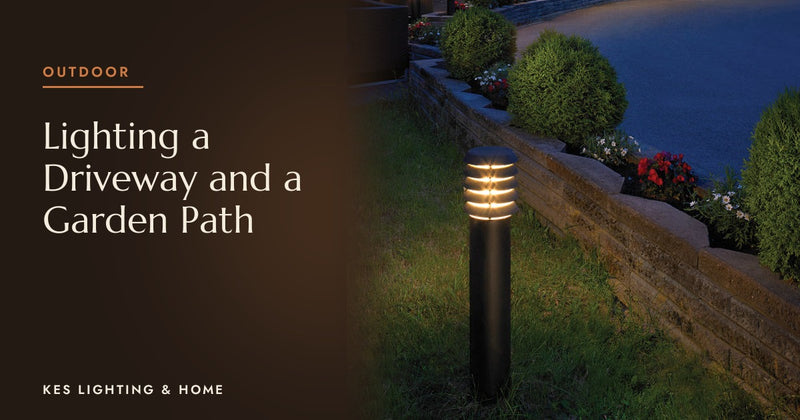
The exception is a long drive. Light the entrance, the bend and the parking spot rather than trying to light the whole length from one point. Our guide to lighting a driveway and a garden path covers the spacing, and when a bollard beats a post.


Which lamp, and how many?
Read the cap and the maximum wattage off the post's own Details table before you buy a single bulb. Most of the range takes an E27 screw cap: 19 of the 24. Four models take the smaller E14: the Feiss English Bridle, the Quintiesse Alford Place, the Elstead Philadelphia Large and the Kichler Tournai. The Alford Place is capped at 40W per lamp across four lamps. Buy four E27 bulbs for an Alford Place and you will have bought the wrong thing four times.
Count the heads. A three-head Norfolk needs three lamps, not one, and no post in our range comes with them. For an E27 post, our GLS LED filament lamp in warm white (£9.60, checked 26 October 2026) gives around 800 lumens at 2700K from under 10W, which sits within the maximum every E27 post in the range allows, including the Norlys posts rated for 15W or 18W LED lamps. Three of those in a Norfolk is £28.80 on top of the post, which is the line that goes missing when people compare two quotes. Our guide to which bulb a light needs covers caps and shapes.
One opinion on colour. Keep an outdoor post at 2700K. Cooler light outdoors looks like a car park, and warm light at the end of a drive is the thing that makes a house look lived in from the road.

How deep should a lamp post footing be?
A lamp post is a lever. Ten kilos of aluminium 2.3 metres in the air, with a gale pushing on it, puts a surprising load on whatever is holding the base. Set it in concrete. Our starting point for a post of this size is a hole roughly 450mm square and 450mm deep, with the base plate bolted to the cured concrete or the column root set directly into it, and the conduit for the cable brought up through the middle before you pour. That is our rule of thumb, not a regulation: no Building Regulation specifies the footing for a garden lamp post. The check is the maker's own instruction sheet, because some of these posts bolt down and some root in, and the two want different holes. Where the sheet gives a size, the sheet wins.
What there is, is physics, and a post that leans after the first winter was nearly always set in soil. Get the conduit in before the concrete goes off. Retrofitting a cable route through a finished footing is a genuinely miserable afternoon.
How do you wire a garden lamp post, and what is yours to do?
This is the question the customer asked us last week, so here is the plain answer: a registered electrician wires it, and you do the planning and, if you want to save the labour, the digging. What follows is what the rules say, not a method.
The cable
Under Regulation 522.8.10 of BS 7671, a cable buried in the ground must have an earthed armour or metallic sheath, or run in a conduit or duct giving equivalent protection, its route marked with cable covers or marker tape, at a depth sufficient to avoid damage from any reasonably foreseeable disturbance of the ground (IET Wiring Matters). BS 7671 itself sets no figure. The IET's guidance tabulates a general minimum of 0.5 metres and says deeper may be needed, so the depth is the electrician's decision for your ground, not a number to take from a forum.
The connection
In England, Part P of the Building Regulations covers fixed lighting in gardens, as Approved Document P says in paragraph 2.2. Installing a new circuit is notifiable work (regulation 12(6A), paragraph 2.5), so it must be self-certified by a registered competent person, certified by a registered third-party certifier, or notified to building control (paragraph 3.1). Adding a lamp post to an existing outdoor circuit is not notifiable in England, because outdoors is not a special location there (paragraph 2.7), but paragraph 3.13 says it should still be designed, installed, inspected, tested and certificated to BS 7671. The 2013 edition is the current one on gov.uk.
Wales keeps a wider scope: outdoors counts as a special location there, so adding a lighting point outdoors is notifiable (gov.wales, Planning Portal). Scotland works to its own building standards, which expect installations to BS 7671, inspected and tested by people with sufficient technical knowledge, skills and experience (gov.scot). In Northern Ireland, ask building control before work starts.
The RCD
Since the 18th Edition, Regulation 411.3.4 has required additional protection by a 30mA RCD for lighting circuits in homes (IET, Professional Electrician), and Electrical Safety First's garden advice is to use an RCD with all outdoor electrical equipment. The current edition is BS 7671:2018+A4:2026 (IET). If a post trips the RCD after rain, our guide to outside lights tripping the electrics covers what you can safely check and where it stops.
Our recommendation, which goes further than the law
Have a registered electrician do the whole thing, including the earthing and the RCD protection, because the one part of this job you cannot inspect afterwards is the bit buried in your lawn. Notifiable work needs a Building Regulations compliance certificate, and you can check an electrician's registration on the Electrical Competent Person register.
- Yours: choosing where it goes, laying the parts out, assembling the post above ground, and the trench and footing once the electrician has agreed the route, the depth and any existing services.
- The electrician's: the cable, the connection, the RCD, the earthing, the test and the certificate.
- Nobody's: a flex across the lawn, or a twin-and-earth cable in a trench because it was in the shed.
What is actually in the box?
Open the box and lay every part out before the electrician arrives. This is where our own reviews are least flattering and it would be dishonest to leave it out.
David S. gave the Endon Burford 3 Light one star on 24 July 2026 because 'it didn't come with a parts list and didn't come with assembly instructions'. Paul B. gave the Elstead Norfolk four stars on 6 March 2025 and said 'The only small negative is there were no assembly instructions provided'. Barrie T. gave the same post five stars on 28 April 2024 and found it 'Easy to put together and install'. Karen F., five stars on 27 July 2023: 'Electrician that fitted it was so impressed with it too'.
So it is inconsistent rather than universal, and it is a supplier packing issue rather than a design fault. Two things make it a non-event. Count the parts against the product page dimensions before the electrician books in, and if anything is missing, ring us. We are in Warwickshire, Monday to Friday, and somebody here has handled the product.
The short version
- 1.8 to 2.4 metres suits most front gardens (our rule of thumb). Fixed-height posts run 1,790mm to 2,950mm; sectional Norlys columns 1,540mm to 3,150mm.
- IP44 or better. Check it: four in our range are IP43 and three, including both Burfords, state no IP at all.
- One post with three heads beats three posts with one head.
- Read the cap. Four models take E14, not E27, and lamps are never included.
- Set it in concrete with the conduit in place before you pour, to the maker's sheet where it gives a size.
- A new circuit is notifiable work in England; in Wales any outdoor addition is. Buried cable is armoured or ducted and marked. Use a registered electrician.
- Lay the parts out and count them before the electrician arrives.
Frequently asked questions
How high should an outdoor lamp post be?
Between 1.8 and 2.4 metres for a front garden, in our view. Lower than that and you look straight into the lamp as you walk past, which makes the path harder to see. Much higher and it reads as a street light rather than part of the house. Our fixed-height posts run from 1,790mm to 2,950mm, and the sectional Norlys columns from 1,540mm to 3,150mm, which suits sloping ground.
How deep should a lamp post footing be?
Our starting point for a domestic post of around 2 to 2.5 metres is a concrete footing roughly 450mm square and 450mm deep, with the cable conduit brought up through the middle before the concrete is poured. No Building Regulation sets this. The maker's instructions win where they give a size, and some posts bolt to a plate while others root straight into the concrete.
Do you need planning permission for a lamp post?
Not normally, for an ordinary garden post at an ordinary house. A conservation area, a listed building or a lighting condition on your planning history changes that, and councils have taken enforcement action over garden lighting at listed buildings. We are lighting merchants rather than planners, so if any of those apply, ask your local planning authority before you dig.
How do you wire a garden lamp post?
With armoured or ducted cable in a trench, marked with cable covers or marker tape, at a depth the electrician sets for your ground, and a registered electrician making the connections with 30mA RCD protection. In England a new circuit is notifiable work under Part P of the Building Regulations; in Wales any outdoor addition is. We do not give wiring steps, and nor should anyone selling you the post.
Are bulbs included with a lamp post?
No, on every post in our range. Count the heads, read the cap off the Details table and buy that many lamps. Most of ours take E27, but four models take the smaller E14, including the Feiss English Bridle and the Quintiesse Alford Place, and the Alford Place is capped at 40W a lamp. Our E27 GLS LED gives around 800 lumens at 2700K and costs £9.60, checked 26 October 2026.
Can a lamp post go on a sloping driveway?
Yes, and it is the one case where we would pay more. A fixed-height post on a slope either buries its base or leaves the plate proud. The Norlys Lund and the Norlys Turin come as sectional columns with a height range, 1,700 to 2,300mm and 1,850 to 2,750mm, so you can set the lantern level with the house rather than level with the ground it stands on.