Because water has got inside the light, or the cable feeding it, and a small current is leaking to earth. The RCD in your consumer unit is built to switch off at a leak of 30 milliamps or less, so it trips. Switch that circuit off at the consumer unit and leave it off, then look for the wet fitting. If it trips more than once, book a registered electrician. Do not keep resetting it.
That is the whole answer in most cases we hear about after a wet week. The rest of this guide is where the water gets in, what you can safely check yourself (and where that stops), how to tell a faulty light from a faulty circuit, what an electrician will do, and why the outdoor LED that survived the rain is now flickering. The clocks went back on 25 October (gov.uk), so the outside lights are now on for the wettest, darkest stretch of the year. This is the week the weak fitting gets found out.
What does it mean when an outside light keeps tripping the RCD?
It means current is leaving the circuit somewhere it should not, and the RCD has noticed. An RCD, a residual current device, compares the current going out on the live conductor with the current coming back on the neutral. In a healthy circuit the two are equal. If some of that current finds another route to earth, through water, through damaged insulation or through a person, the two no longer match and the device disconnects the supply. That is the IET's description in its guide to inspecting and testing RCDs, and it is why the RCD, unlike a fuse or a circuit breaker, trips on a leak rather than an overload.
The figure that matters is 30 milliamps. The Health and Safety Executive says that to reduce the likelihood of injury to people an RCD should have a tripping current of not more than 30mA, and that is the rating on the RCD protecting your lights. The BEAMA RCD handbook puts it in perspective: the smallest fuse in a plug is 3 amps, and it takes less than one twentieth of that to kill an adult. So a 30mA RCD is doing exactly what it is for when a wet lantern trips it. It is the symptom, and it is the thing keeping the symptom from becoming something worse.
One more thing that confuses people. The leak does not have to be dramatic. BEAMA lists wet plaster, condensation and a build-up of small standing earth leakage from several pieces of equipment on the same RCD among the causes of what it calls unwanted tripping. An old lantern with a weeping seal might leak a little on its own, and tip the whole circuit over the edge only when the rain adds a little more. That is why a light that works fine when it dries out is still a fault.
Why do my outside lights only trip when it rains?
Because the leak needs water to complete it. Dry, the gap between a live terminal and the earthed metal body is air, and air does not conduct. Wet, a film of rainwater bridges the gap, the current leaks, the RCD trips. Let it dry and the bridge disappears, which is why the circuit resets and holds, until the next downpour. The water is getting in through one of a short list of places.
| Where the water gets in | What you tend to see | Who sorts it |
|---|---|---|
| The gasket or seal between the glass and the body | Droplets or misting inside the glass; a green or white crust on the lampholder | A registered electrician: the fitting usually needs replacing |
| The cable entry or gland at the back | The cable enters from above and rain runs down it into the back box; or the entry was never sealed | A registered electrician |
| A fitting mounted the wrong way up | An IP-rated fitting whose drain holes now face the sky, or a down light fitted as an up light so the lamp sits in a cup of water | A registered electrician to re-fit it; you can spot it from the ground |
| Cracked or missing glass | Obvious once you look, often after a ladder or a football | A new glass or a new fitting, with the power off |
| A junction box in the garden or on the wall | A plastic box with a lid that no longer seals, or an indoor box used outdoors | A registered electrician |
| A damaged buried cable | Trips after heavy rain with every fitting dry; a spade, a fence post or a root has reached the cable | A registered electrician with a tester; nobody else |
| A tired fitting | Perished rubber, a lampholder gone brittle, rust where the back plate meets the wall | Replace it; a new fitting is cheaper than the call-out |
The table is ours, drawn from the faults that come back to us. Treat the right-hand column as the rule. Three of these you can confirm with your eyes from the ground, and none of them with a screwdriver.
The one people miss is orientation. An IP rating assumes the fitting is installed the way the leaflet shows. Astro's Oslo 100 datasheet lists the installation orientation as 'Wall Mount - Down or Up Light' because that particular fitting is designed for both, and it says so; most are not. Fit a down-only lantern pointing up and the glass becomes a bowl that fills with rain and sits against the lampholder. If your light was fitted by whoever was on the ladder that day, look at it against the picture on its own listing. Our outdoor IP rating guide explains what the two IP digits promise and, just as usefully, what they do not.
Is it dangerous if the RCD keeps tripping? Should I leave the circuit off?
Leave it off. An RCD that trips repeatedly is telling you there is a fault, and Electrical Safety First is blunt about it: if the RCD in your fusebox keeps tripping, there is likely to be a fault that needs investigating, and a registered electrician should investigate it. The RCD is not the problem. Resetting it ten times does not make the leak smaller; it just gives the fault ten more chances to find a different path.
Is it a fire hazard? Water leaking current to earth through an RCD-protected circuit is, in the first instance, a shock risk that the RCD is managing, which is why the circuit keeps going off. The fire question is about what happens where the water sits. BEAMA's handbook describes surface tracking, where moisture and deposits let a conducting path grow across insulation until it heats, and notes that currents of 50 to 100mA have been found sufficient to cause ignition by tracking. A 30mA RCD trips well below that. The plain answer is that the RCD is the thing standing between a damp lantern and a worse outcome, and the way to respect it is to stop overriding it. Scorch marks, a smell of hot plastic, buzzing from the fitting or the consumer unit, or an RCD that will not reset at all: those are not wait-for-a-dry-day signs. Switch the circuit off and call an electrician the same day.
One other thing to rule out before you blame the garden. If the RCD covers more than one circuit, the leak may be somewhere else entirely. Trip-at-random, every-few-hours faults are often an appliance (a kettle element, a washing machine heater, an old fridge) and nothing to do with the lights. The test for that is in the next section, and it costs nothing.
What can I safely check myself before calling an electrician?
Four things, all with the power off, and none of them involve a screwdriver. This is where the homeowner's job ends, and we mean that. Anything on the mains side of a wall light is work for a registered electrician, and we are a lighting merchant, not an electrical contractor, so this is the list we give our own customers.
- Isolate the circuit at the consumer unit. Switch off the circuit breaker for the outside lights, rather than only the wall switch, and leave the RCD off if it has tripped. The wall switch is not isolation.
- Look, from the ground or a stable step. Misting or droplets inside the glass, a cracked panel, a cable entering from the top without a drip loop, a lantern pointing the wrong way, a junction box with a lifted lid, a fitting that has gone chalky and rusty at the base. Take photos; the electrician will thank you.
- Let it dry out. Leave the circuit off for a dry day. If the RCD then holds, you have a water fault, and you know which weather sets it off. That does not make it fixed.
- Narrow it to one fitting, by switching, not by unscrewing. If the outside lights are on their own circuit and each has its own switch, switch all of them off, reset the RCD, and bring them on one at a time at the wall switch. The one that trips it is your suspect. If they all share one switch, stop here: isolating fittings individually means opening them, and that is the electrician's job.
Then stop. Do not open the fitting, do not loosen the gland, do not dry the terminals with a hairdryer, and do not replace the RCD (more on that below). Electrical Safety First's garden advice is to use an RCD with all outdoor electrical equipment and to check equipment has not been affected by water before using it; it does not invite you to take the equipment apart. What you have after those four steps is a diagnosis worth having: the circuit, the weather, the fitting, the photos. An electrician who arrives with that is twenty minutes into the job before the van door closes.
| Do | Do not |
|---|---|
| Switch off at the consumer unit and leave it off | Reset the RCD repeatedly and hope |
| Look for water, cracks, orientation and lifted lids | Open the fitting or the junction box |
| Switch fittings on one at a time at the wall switch | Unscrew a fitting to isolate it |
| Photograph what you find | Dry terminals with a cloth or a hairdryer |
| Press the RCD test button once the fault is fixed | Swap the RCD for a 'less sensitive' one |
| Book a registered electrician | Bypass or disconnect the RCD |
Is it the light that is faulty, or the circuit?
Usually the light, or the last metre of cable into it, and the switching test above is how you find out without tools. A few patterns from our returns desk, offered as patterns rather than proof:
- It trips the moment one particular light is switched on, wet or dry. That fitting, its lampholder or its connection. A new fitting that does this from day one has either a fault or a wiring error at the back; either way it goes back to whoever fitted it.
- It trips only after prolonged rain, with every fitting dry inside. Suspect the cable run or a buried joint. The RHS advises burying garden cables about 60cm down with warning tape above, and NICEIC says outdoor cabling should be suitable for outdoor use and buried deep enough to avoid damage from garden tools. A cable that was never any of those things is a candidate.
- It trips at random, in any weather, on a circuit shared with sockets. Probably not the lights at all. Unplug appliances one at a time before you blame the lantern.
- It trips when the new LED spotlights come on, several at once. Each LED driver leaks a little to earth by design; BEAMA lists high standing earth leakage as a cause of unwanted tripping. Several on one RCD, plus a damp joint, can add up. Collingwood is unusual in printing an earth leakage figure on its floodlight datasheet. This is one for the electrician to measure, not a reason to fit a bigger RCD.
- An older house where the garden lights were added 'by a mate'. Ageing rubber or PVC insulation on the outdoor run can leak once it is wet. An electrician will put an insulation resistance tester on it and tell you in minutes.
What the electrician does with the suspect: isolates it properly, opens it, inspects the seal, the gland and the terminals, and tests the insulation resistance of the circuit with the fitting disconnected. If the circuit tests clean with the fitting off, it was the fitting. If not, they walk the cable. That is a diagnosis you cannot buy a tool for in a DIY shed, and it is the part worth paying for.
Can I replace an RCD myself?
No. Two reasons, and the first is the law. Work inside the consumer unit sits under Part P of the Building Regulations in England. Approved Document P (2013 edition, gov.uk) lists the replacement of a consumer unit among the work that must be notified to building control unless it is done and certified by a registered competent person, and it brings fixed lighting on outside walls and in gardens inside Part P's scope (paragraph 2.2). Wales has its own version, and Scotland and Northern Ireland run separate regimes. A registered electrician, which in England and Wales means NICEIC, NAPIT or BFC according to Electrical Safety First, can self-certify the work and give you the paperwork. You cannot.
The second reason is the one that matters even where the law is quieter. An RCD that keeps tripping is almost never a faulty RCD; it is a working RCD reporting a fault. Swapping it for a new one, or for one rated at 100mA because somebody online said the 30mA one is 'too sensitive', leaves the leak exactly where it was and removes the protection. The 18th edition of BS 7671 brought in a requirement for 30mA RCD protection on lighting circuits in domestic premises (the IET's article on the 18th edition changes sets out regulation 411.3.4), and the standard is now at BS 7671:2018+A4:2026. That 30mA figure is not a nuisance setting. It is the level chosen to protect a person.
The symptoms of a genuinely faulty RCD are different: it will not reset even with every circuit it protects switched off, or it does not trip when you press its test button. Electrical Safety First says RCDs can be checked using the test button, and if that does not work a registered electrician should investigate. BEAMA recommends pressing the test button at least every six months. Either symptom is still a job for the electrician, who may replace the device or fit an RCBO so the outdoor lights have their own protection and stop taking the kitchen down with them.
What it costs: we could not find a reliable published price for swapping a single RCD on its own, so here is the honest version. MyJobQuote's cost guide (updated 1 October 2026) puts an electrician at around £45 to £75 per hour, or £220 to £350 per day, and a full consumer unit replacement at £350 to £750 including materials. A fault-find on an outdoor circuit is usually an hour or two plus the fitting. A new wall light is often the cheapest part of the bill, which is a point in favour of buying one that stays dry.
Which outdoor lights stay dry, and do not trip the RCD in the rain?
The ones with a proper gasket, a sealed cable entry and an IP rating that matches the wall, fitted the right way up by someone who read the leaflet. No fitting is immune to a bad installation. But some are built so there is far less to get wrong, and this is what we would choose.
For an exposed wall that takes the weather, our rule of thumb is IP65: dust-tight and tested against jets of water rather than splashes. Our IP65 vs IP44 guide has the detail. The Astro Kea 150 Round in textured black (£75.90, checked 26 October 2026) is a sealed aluminium disc, 150mm across and 55mm deep, with an integral LED giving 566 lumens at 3000K according to Astro's datasheet, IP65, no lamp to change and so no lampholder to corrode. The Astro Mast in textured black (£49.25, checked 26 October 2026) is the same idea at a lower price: a 135mm cone, IP65, taking one GU10 up to 6W that you can replace from below without disturbing the seal. It has four five-star reviews on our site and no complaints. Astro's standard range datasheets say the fittings are not suitable within five miles of the coast; if that is you, read our coastal outdoor lighting guide first.


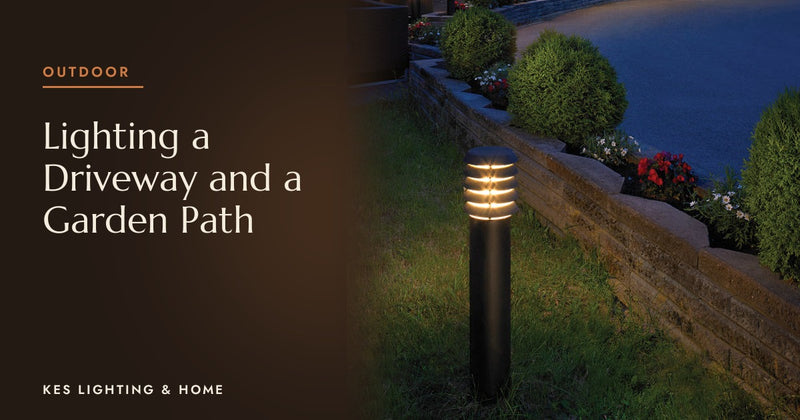
For a traditional lantern, buy cast aluminium with a long anti-corrosion guarantee and glass panels set in a frame rather than loose in it. The Elstead Chapel Mini down lantern in black (£64.45, checked 26 October 2026), the light in the photograph at the top of this guide, is 380mm tall, IP44, cast aluminium with a 10 year anti-corrosion guarantee, and takes one E27 lamp up to 60W. IP44 is right for a lantern under an eave or beside a door; it is not what we would put on a gable end that faces the prevailing wind. Our front door lighting guide covers which lantern goes where.

For a floodlight, buy one where the LED, the driver and the body are one sealed unit. The Collingwood 20W colour switchable floodlight (£37.04, checked 26 October 2026) is IP65, cast aluminium, rated to work from minus 40 to plus 40 degrees, supplied with a metre of rubberised cable so the only joint is the one your electrician makes in a proper outdoor box, and carries a five year warranty; those figures are from Collingwood's datasheet. The datasheet also calls it flicker-free, which brings us to the second half of this guide.

Whichever you choose, the fitting is half the job. Where the cable comes from, how it is jointed and whether the circuit has its own RCD protection are decided before the light goes on the wall, and our driveway and garden path guide sets out who can fit what outdoors and when the work is notifiable. Lamp posts have their own rules, and their own guide.
Why do my outdoor LED lights flicker, and should I turn them off?
Outside, flicker is nearly always the driver, moisture, the sensor or a loose connection, in roughly that order. The one cause everybody reaches for first, a dimmer that cannot cope with LED, is real but rare outdoors because few outside lights are dimmed; if yours is, read our guide to dimming LEDs and come back. Here is how to tell the others apart.
| What you see | Likely cause | What to do |
|---|---|---|
| One integral LED fitting flickers, the rest are fine, any weather | A failing driver inside the fitting (LEDVANCE lists defective drivers, and their susceptibility to heat over time, as a cause) | Switch it off at the wall. Under warranty, claim it; the driver is usually not replaceable on its own, so the fitting is |
| Flicker starts after rain, clears when dry, then the RCD trips | Moisture at the lampholder or driver; the same fault as the tripping, caught early | Treat it as a tripping fault: isolate, look, dry, electrician |
| A PIR or sensor light flickers or pulses rather than coming on cleanly | A sensor at the edge of its light-level setting at dusk, a lamp the sensor cannot switch properly, or a sensor failing | Check the settings in the leaflet first (our PIR guide covers them); then a replacement sensor or fitting |
| A lantern with a separate bulb flickers; a new bulb fixes it | The bulb, or a corroded lampholder it could not seat in | A new bulb; if the holder is green or crusty, a new fitting |
| A brand new bulb flickers from the first evening | A faulty bulb, a non-dimmable LED on a dimmer, or a lamp the sensor circuit cannot run | Swap the bulb for another of the same type; if that flickers too, it is the switch, sensor or wiring |
| Every outside light flickers together, or the indoor lights dip at the same moment | A loose connection on the circuit, or a supply problem | Switch the circuit off and call a registered electrician. This one is not a bulb |
The second column leans on LEDVANCE's guide to LED flicker, which names defective drivers, loose wiring or loose bulbs, incompatible dimmers, low-quality lamps and voltage fluctuation as the usual suspects. The third column is ours.
Should you turn a flickering light off? Yes, at the wall switch, and if it is flickering and tripping, at the consumer unit. A driver on its way out is wasting your evening, nothing more, but a flicker that comes with heat, a smell, buzzing or lights dipping elsewhere in the house is a loose connection, and a loose connection is the kind of fault that can arc. That is the fire-hazard case, and it is an electrician's job, not a bulb's. Can flickering lights be a fire hazard? On their own, a bad bulb or driver, no. As a symptom of a loose connection, yes, which is why we say switch it off and find out rather than live with it.
On the bulb: we stock the lamp we would reach for in a GU10 outdoor fitting such as the Mast, the Astro GU10 LED 4.1W 2700K dimmable (£8.76, checked 26 October 2026), 500 lumens, which one customer summed up as 'Dims right down to nothing. No flickering.' Buy a dimmable lamp even if you are not dimming it; it tends to be the better-built one. Our guide to which bulbs your new light needs covers caps and sizes. For a fitting that runs off a separate driver, the driver needs a dry home: Astro's CC 700mA driver (£38.95, checked 26 October 2026) is rated IP20, so it belongs inside the house or in a sealed enclosure specified by your electrician, never behind a lantern on an outside wall. If an outdoor LED on a remote driver starts flickering, the driver's position is the first thing we would ask about.
And on sensors: a PIR lantern that switches a separate bulb, such as the Elstead Wexford up lantern with PIR (£71.02, checked 26 October 2026), lets you prove or clear the bulb in thirty seconds by swapping it. Elstead's listing gives the sensor a 1 to 8 metre range over 120 degrees and a 5 second to 7 minute stay-on time; a lantern pulsing at dusk is usually sitting on the edge of its light-level setting. A sealed PIR floodlight such as the Collingwood 20W PIR floodlight (£39.75, checked 26 October 2026) removes the bulb question entirely, and Collingwood's datasheet gives it an override to leave it permanently on or off, which is also the quickest way to tell a sensor fault from a light fault. Placement and the three dials are in our PIR security light guide.


The short version
- A light that trips the RCD in the rain is leaking current to earth through water. The RCD is working; the fitting or cable is not.
- Switch the circuit off at the consumer unit and leave it off. Resetting it repeatedly fixes nothing and removes your protection.
- Your checks: isolate, look (misting, cracks, orientation, lifted lids), dry out, then one fitting at a time at the wall switch. Then stop.
- Never open the fitting, dry terminals or swap the RCD. Consumer unit work is notifiable under Part P in England; use a registered electrician.
- For an exposed wall buy IP65 with a sealed body (Astro Kea or Mast); for a lantern, cast aluminium with a long anti-corrosion guarantee (Elstead Chapel Mini).
- Outdoor LED flicker is the driver, moisture, the sensor or a loose connection. Switch it off; if lights dip elsewhere too, call the electrician the same day.
Frequently asked questions
Why do my outside lights keep tripping when it rains?
Rain is getting into the fitting, the cable entry or a joint, and a small current is leaking to earth through the water. The RCD is designed to trip at 30mA or less, so it switches the circuit off. When the fitting dries the leak stops and the RCD holds, which is why it seems to fix itself. It has not. Isolate the circuit, look for the wet fitting and book a registered electrician.
What is the most common cause of an RCD tripping?
A leak to earth, and on an outdoor circuit that nearly always means water: a perished seal, an unsealed cable entry, a fitting mounted the wrong way up, a junction box with a lifted lid, or a damaged buried cable. On a shared RCD, a faulty appliance such as a kettle or washing machine heater can trip it just as readily, so unplug appliances before you blame the garden.
How do I reset my RCD?
Switch off everything the RCD protects, then move the RCD switch fully off and back on. If it holds, bring the circuits back one at a time to find the one that trips it. If it trips again straight away, or will not reset with everything off, leave it off and call a registered electrician. Do not keep resetting an RCD that keeps tripping.
Is it a fire hazard if the RCD keeps tripping?
The RCD tripping is the protection working, and a wet fitting on a 30mA RCD is being disconnected well below the current levels that cause ignition by tracking. The risk comes from ignoring it. Scorch marks, a hot smell, buzzing, lights dipping elsewhere or an RCD that will not reset are same-day electrician signs. Switch the circuit off and leave it off.
Can I replace an RCD myself?
No. Replacing a consumer unit is notifiable work under Part P of the Building Regulations in England, and the practical reason is stronger: an RCD that keeps tripping is almost never faulty, it is reporting a fault. Swapping it, or fitting a less sensitive one, leaves the leak in place and removes the protection. A registered electrician can test it, replace it if needed and certify the work.
What are the symptoms of a faulty RCD?
It will not reset even with every circuit it protects switched off, or it does not trip when you press its test button. Electrical Safety First says the test button is how to check it, and BEAMA recommends pressing it at least every six months. An RCD that trips when the lights come on in the rain is not faulty; it is doing its job. Either way, the fix is a registered electrician.
Why do my LED lights flicker even though the bulbs are fine?
Outside, it is usually the driver inside an integral LED fitting failing, moisture at the lampholder, a sensor at the edge of its light-level setting, or a loose connection. Swapping the bulb proves or clears the bulb; if a new one flickers too, look at the switch, sensor or wiring. If other lights dip at the same moment, switch the circuit off and call a registered electrician.
Should I turn the light off if it flickers?
Yes. A failing driver or bulb is harmless but worth switching off until it is replaced. A flicker that comes with heat, a smell, buzzing, or lights dipping elsewhere in the house points to a loose connection, which can arc, so switch that circuit off at the consumer unit and have it looked at. A flicker followed by the RCD tripping is a water fault; treat it as one.